
This week a lot of people online were talking about the Nicene Creed. Some asked, “Is that a Catholic thing? A Protestant thing?” The good news is simple: it belongs to all Christians. Catholic, Orthodox, and Protestant believers all confess it. It is one of the oldest summaries of the faith we have.
Where it came from
Around the year 318, a teacher in Alexandria named Arius began teaching that the Son of God was a created being. Great, but not truly God. That caused a storm.
In 325, about 300 bishops met at Nicaea (in modern Turkey). They wrote a short statement saying the Son is “of one being with the Father.” In 381, a second council at Constantinople expanded it, especially the part about the Holy Spirit. That 381 version is what most Christians recite today.
The three big parts
The Creed is built like the Bible’s own story: Father, Son, and Spirit.
1. The Father. “We believe in one God, the Father, the Almighty, maker of heaven and earth, of all that is, seen and unseen.”
There is one God, and he made everything.
2. The Son. This is the longest part, because it was the part under attack. It says Jesus is “eternally begotten of the Father, God from God, Light from Light, true God from true God, begotten, not made, of one Being with the Father.”
In plain words: Jesus is not a creature. He is fully God. Then it tells his story: he “came down from heaven,” became man, “was crucified under Pontius Pilate,” “suffered death and was buried,” rose “on the third day,” ascended, and “will come again in glory to judge the living and the dead, and his kingdom will have no end.”
3. The Spirit. “We believe in the Holy Spirit, the Lord, the giver of life.” The Spirit is God too, worshiped and glorified with the Father and the Son, and he “has spoken through the Prophets.”
It ends with hope: “We look for the resurrection of the dead, and the life of the world to come.”
So where is “grace through faith”?
Some asked why the Creed doesn’t spell out “saved by grace through faith.” The Creed wasn’t written to answer every question. It was written to protect the answer to one question: Who is Jesus? It does say he came “for us and for our salvation.” The Bible fills in how we receive that: “For by grace you have been saved through faith. And this is not your own doing; it is the gift of God” (Ephesians 2:8, ESV).
A small word you may notice
In many Western versions the Creed says the Spirit proceeds “from the Father and the Son.” That phrase was added later in the West (first at a council in Toledo, Spain, in 589) and is still discussed between East and West. The heart of the Creed is the same either way.
Why it matters
The Creed is not a replacement for Scripture. It is a summary of what Scripture says, written by believers who were willing to suffer for it. When you say it, you are standing with Christians across 1,700 years who answered Jesus’ question, “Who do you say that I am?” (Matthew 16:15, ESV), with the same words.
Timeline
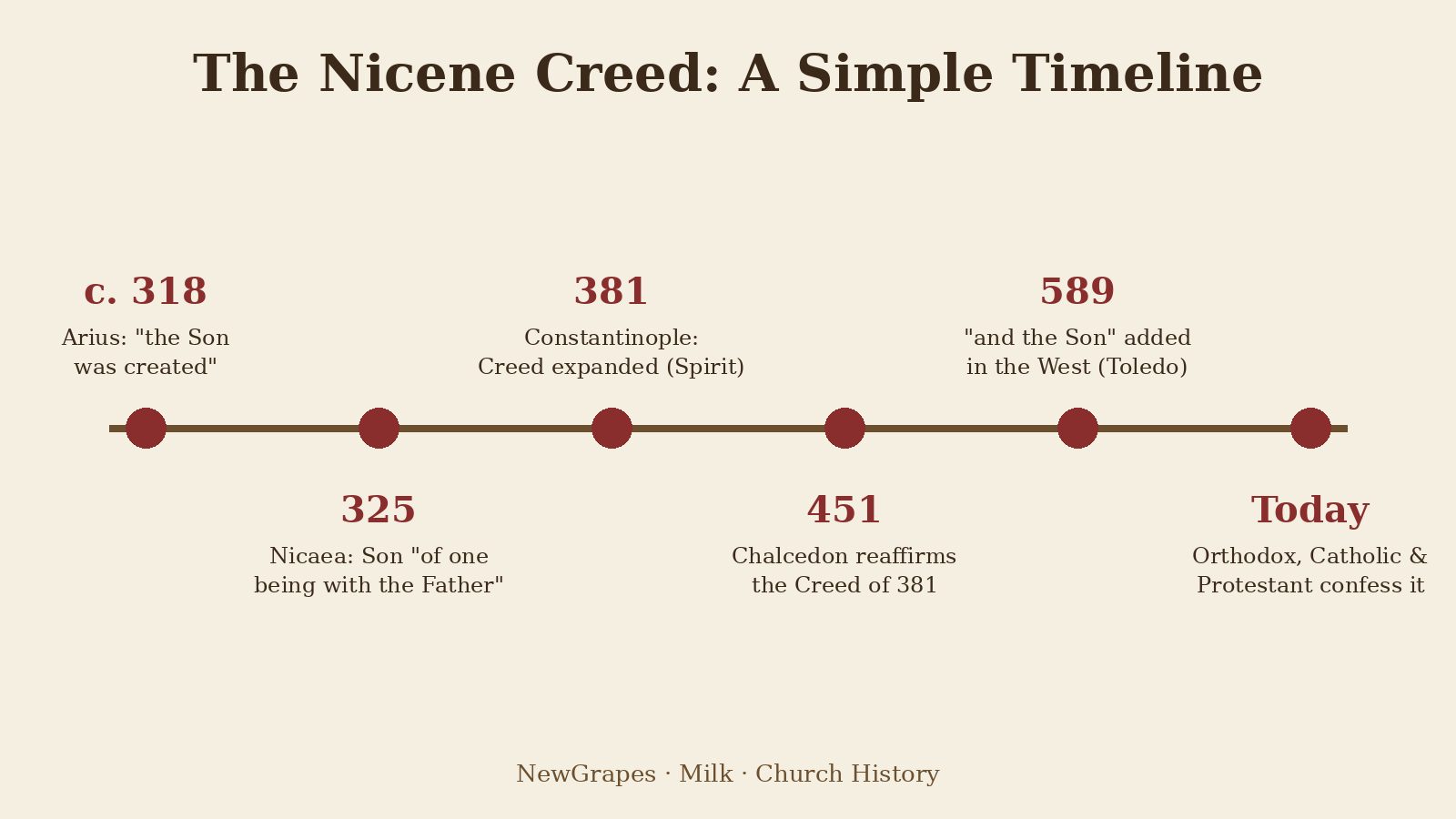
- c. 318: Arius teaches the Son was created
- 325: Council of Nicaea, the Son is “of one being with the Father”
- 381: Council of Constantinople expands the Creed (the Holy Spirit)
- 451: Council of Chalcedon reaffirms the Creed of 381
- 589: “and the Son” added in the West (Toledo)
- Today: confessed by Orthodox, Catholic, and Protestant Christians
Sources
- Creed text: English Language Liturgical Consultation (ELLC) translation, Praying Together (1988).
- J. N. D. Kelly, Early Christian Creeds, 3rd ed. (Longman, 1972).
- Justo L. González, The Story of Christianity, vol. 1 (HarperOne, rev. 2010).
- Scripture quotations from the ESV®, © 2001 by Crossway.