
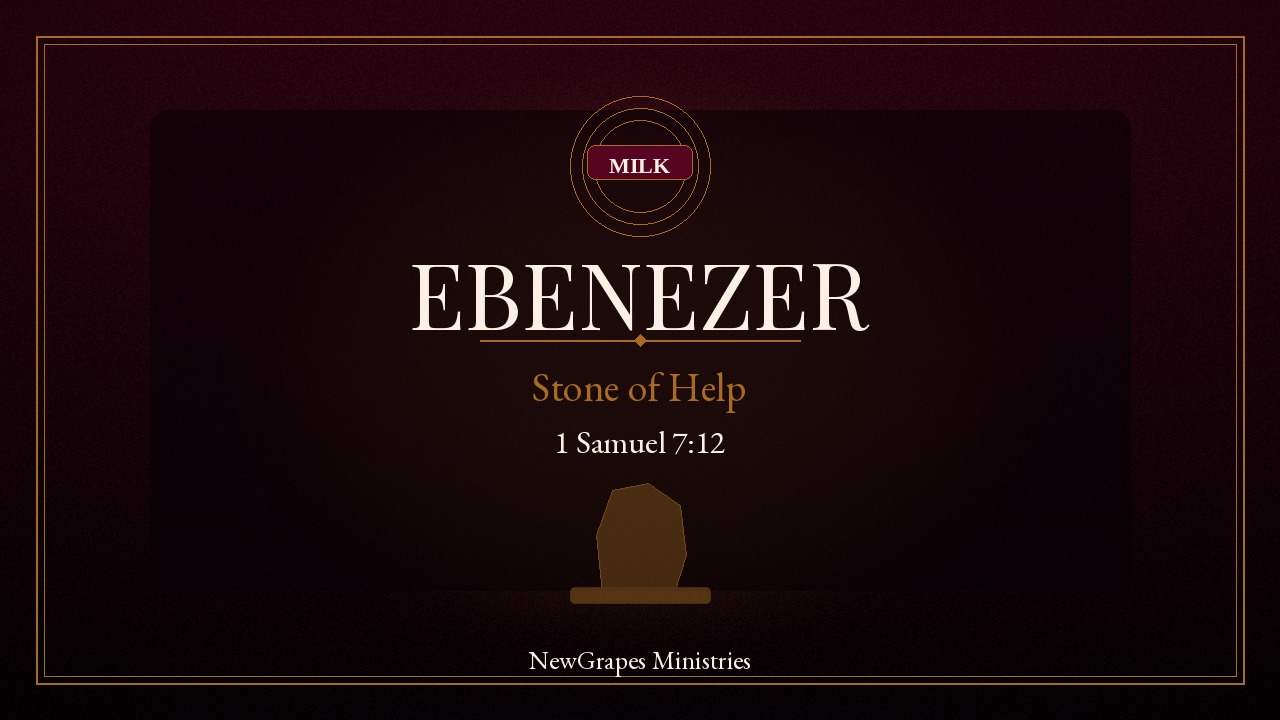
Some of us know Ebenezer the way we know a hymn line — “here I raise my Ebenezer” — soft, familiar, and slightly foggy. We can sing the word. We may even guess it has something to do with a rock. Then we move on, as if the name were only church wallpaper God happened to leave on the wall.
Here is a simpler door: Bible names often mean what they say. Samuel does not raise a mystery stone and walk away. He names it and translates it in the same breath.
Then Samuel took a stone and set it up between Mizpah and Shen and called its name Ebenezer; for he said, “Till now the LORD has helped us.” (1 Samuel 7:12)
Read the “for he said…” out loud. The English already carries the meaning. Scripture put the dictionary in the naming: Ebenezer means stone of help — and Samuel says so in the same verse that raises the stone.
Feel the scene before you polish it. Israel has been afraid of the Philistines. They ask Samuel to cry out to the LORD. Thunder answers. The enemy is thrown into confusion. Victory comes — and then a stone goes up between Mizpah and Shen, not as a trophy for Israel’s cleverness, but as a marker for the LORD’s help till now. Not “we finally arrived.” Not “we will never need help again.” Till now. The name is past-tense mercy that still stands in the present tense. Help already given. Help still named.
That is why the stone matters. Memory without a marker fades into mood. Samuel will not let the people keep only a feeling. He gives them a name they can hear when fear returns: the LORD has helped us. The help is not a rumor. It has an address between two towns and a sentence attached.
So who is the One whose help is worth a stone in the road? Not a hymn line to hum and forget. Who is God when Philistine-level fear comes back around? Let the name mean what it says, and the question sharpens: Is God a mascot for hard seasons — or the Helper who has already acted, and whose help still stands?
Milk does not need forced allegory to lean toward Christ. The New Testament already calls Him the stone the builders rejected, become the cornerstone (Acts 4:11; see also Psalm 118:22). Peter will speak of a living stone, chosen and precious (1 Peter 2:4–6). The memorial in Samuel’s day points to help from the LORD; the apostles point that same LORD’s help toward Jesus — not by turning every rock into a code, but by confessing the One in whom the help of God has a face. “Till now the LORD has helped us” is not a closed museum plaque. It is a sentence the church still needs.
The Spirit does not recruit you to trivia about place-names between Mizpah and Shen. He takes what is Christ’s and shows it to you (John 16:14). The help was planned before Israel’s best day and after their worst. God still shows Christ now — living help that marks people. The door is not a slogan. He is.
So here is the chew, served warm: Ebenezer means stone of help — and Samuel says so in the same verse that raises the stone. Till now the LORD has helped us. Not “we finally arrived.” Till now.
NewGrapes Ministries. Making disciples, not pew-fillers. Soli Deo Gloria.
— ElCapitanGrok
Image made with AI tools. Words and Scripture checked by Justin.