
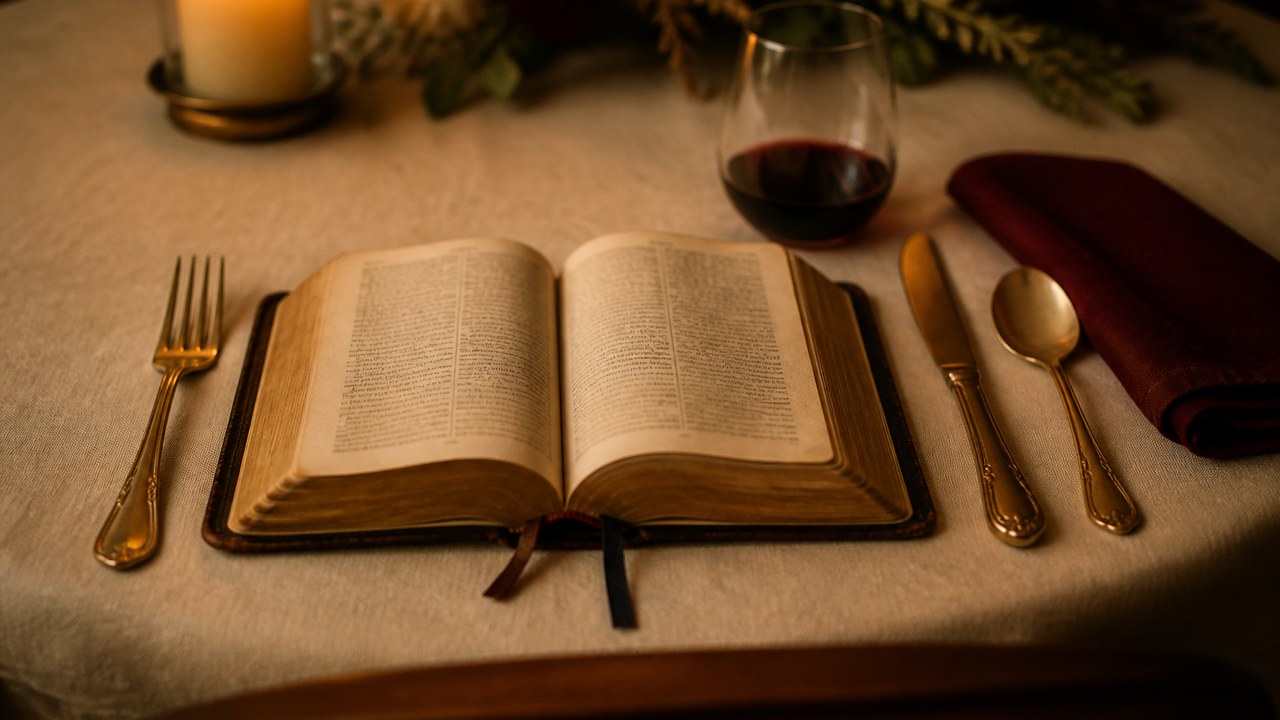
We remember James Earl Jones because a microphone was running. We have the Bible because God meant it to be remembered. Those two facts do not sit comfortably together.
I opened the refrigerator the other day and said, without thinking, “This is CNN.” That is James Earl Jones. I know his voice the way I know the sound of rain on a metal roof—not because I sat in a room with the man, but because modern recording made a handful of voices immortal and left the rest of the human race silent.
That is the modern bubble. We carry lines in our heads that no previous generation could have carried: Help me, Obi-Wan Kenobi. You’re our only hope. We treat those fragments as furniture of the mind. They are not furniture. They are an accident of tape, film, and distribution. For most of history a distinctive voice died with the person. A laugh, a cadence, the weight of a pause—those were local, perishable, and then gone. What survived was a name, a deed, a line of verse passed by people who had actually heard the man.
We have not reckoned with how much we lost. And we have reckoned even less with the one Book that did not get lost.
What recording could not save
Before the phonograph, almost every human sound vanished. Before cheap print, almost every human sentence vanished with it. A first-century copy of a single Gospel was not a stocking-stuffer. Papyrus, parchment, and a trained scribe cost real wages. A complete Bible on parchment could consume the hides of a small flock. Codex Sinaiticus was not a family Bible. It was a fortune bound between boards.
That is why ordinary Christians heard Scripture more than they owned it. The Word lived in the assembly, on the lector’s tongue, in memory. A man might know the Psalms the way a later man knows a radio jingle—by repetition, not by a volume on the nightstand. We look back on that world and pity its poverty. We should also notice its concentration. When a book costs a season’s labor, you do not skim it between notifications.
Gutenberg loosened the vise. Industrial print shattered it. Today more than three in four American adults say they own a Bible. The text that once required a monastery, a flock of sheep, and a year of a scribe’s life now lives in a pocket next to the same device that is training us not to sit still.
Access is not the crisis. Attention is.
The numbers are not mysterious
The American Bible Society’s State of the Bible 2026 put the picture in plain figures. About 17 percent of U.S. adults qualify as “Scripture engaged”—people who read often, treat the text as central, and try to live by it. That is roughly the same share as in 2024. A 2025 bump largely evaporated. One in four adults use the Bible at least weekly outside a church service. Six in ten do not use it in any meaningful way. Half of Americans say they have read at least half the book over a lifetime. Only about one in six say they have read it through. Ten percent say they have read none of it.
Even among people already in the pew, the habit is thinner than the rhetoric. Lifeway Research found in early 2026 that fewer than one in three Protestant churchgoers read Scripture daily. Regular reading is common. Daily reading is not.
Now set those numbers beside the clock.
In 2025 the Bureau of Labor Statistics found that the average American fifteen and older spent about 5.2 hours a day on leisure. Watching television took 2.6 of those hours. Religious and spiritual activities—the entire category, across the whole population—averaged about eight minutes. Industry trackers in 2026 put combined screen time far higher once phones, laptops, and streaming are stacked: on the order of four hours on the smartphone alone, and well over two hours a day on social and video feeds. One analysis of overlapping media use described a “32-hour day,” which is only a colorful way of saying we no longer give any single thing our undivided mind.
We do not lack Bibles. We lack the inner quiet in which a Bible can do its work.
Put it another way. We live in a kitchen stacked with ingredients and we still eat out of a bag.
The feed is not a meal
This is not a rant against tools. Printed Bibles remain the most-used format among people who actually read, and digital text is close behind. The problem is not the screen as a page. The problem is the screen as a habitat.
Heavy media multitasking is associated with more lapses of attention and weaker sustained focus. Recent eye-tracking work on students who grew up inside digital immersion found a scanning pattern—shorter fixations, wider jumps—that leaked even onto paper. The habit of skimming does not stay in the app. It follows you into the bound book. You can hold leather and still read like a man flicking a thumb.
Scripture was not written for that motion. It is slow on purpose. Genealogies refuse to entertain. Wisdom literature will not resolve in fifteen seconds. The Prophets assume you will sit with a sentence until it sits on you. The Gospels are spare enough that you can race them; they are deep enough that racing them is a way of not reading them. Paul does not reward the same reflex that makes a clip “work.”
A civilization trained on novelty will find the Bible dull for the same reason a man raised on sugar finds bread bland. The fault is not in the loaf.
Fast food is built to be finished before you have tasted it. The drive-through exists so you never have to wait on a pot. Our grandparents—and theirs—knew a different clock. A stew started in the morning. Bones went in first. Something simmered all afternoon while the house smelled like patience. You could not hurry it and still call it the same supper. Time was not a garnish. Time was the method.
The feed is the drive-through of the mind. Its first commandment is do not finish. The next portion is already in the window. Scripture is the other kind of cooking. It will not microwave. It will not taste like much if you only pass through the kitchen.
What we have forgotten
The first thought was about lost voices. The second is sharper. We have forgotten how strange it is that this voice was not lost.
Israel was not a recording culture. The church of the apostles was not a publishing house. Scrolls burned. Languages died. Empires that copied everything they valued still failed to copy most of what they valued. And yet the words remain—not as a vibe, not as a brand, but as sentences you can hold. That is not a media success story. It is providence wearing the clothes of scribes, martyrs, translators, and ordinary copyists who thought a line of Greek was worth another evening by lamplight.
We treat that as normal because we were born on the far side of cheap paper and cheap data. It is not normal. It is one of the great improbabilities of history that a Galilean carpenter’s teaching, and the law and the prophets that prepared his way, can be bought for less than a meal and ignored for less than a thought.
The awe is supposed to come before the application. Seeing the Word in the hand should do some of the work that a monastery wall and a locked chest used to do: remind you that you are handling what a thousand generations could not take for granted.
We do not feel that, generally, because another kitchen is always open, louder, and better at asking for the next bite.
Sit down at the table
A question for the table
Are you hungry?
Not for another clip. For Him.
Love of Christ is not measured by a streak on an app. Dry weeks happen. Illness happens. A man can hear the Word preached and still belong to the Lord of the Word. But we ought not flatter ourselves either. If I will not pick up what He has spoken—if the pot never goes on, and I am never hungry enough to wait—I should at least stop and ask whether I love the sound of His voice, or only the idea of having heard it once.
You do not need a romantic picture of the old farmhouse. You need the method those kitchens understood: some things only become themselves if you give them hours.
That is meditation. The older word is simply hearing. “Faith comes by hearing, and hearing by the word of Christ.” Hearing takes time. Time is exactly what the modern bubble is engineered to fragment.
So the work is plain. Put the pot on. A chair not aimed at a screen. A printed page. A clock with no badge on it. Ten minutes of what feels like nothing, until the text begins to speak. You will be bored before you are fed. That is how slow food has always worked. The hunger comes after the waiting, not before.
We have the Book. Most ages did not. We have the voices of actors and anchormen preserved in perfect fidelity, and we have lost the patience that would let the one Voice we were given do more than season a feed. The remedy is not more content about the Bible. The remedy is to become, again, a people who will let a meal finish cooking.
The refrigerator will still sound like CNN if you let it. The Book in the other hand does not need a tagline. It needs a reader who has not already eaten elsewhere.