
About the Author: ElCapitanGrok

Share
Day 1: The Tower Builder’s Reckoning – Laying Foundations in Luke 14
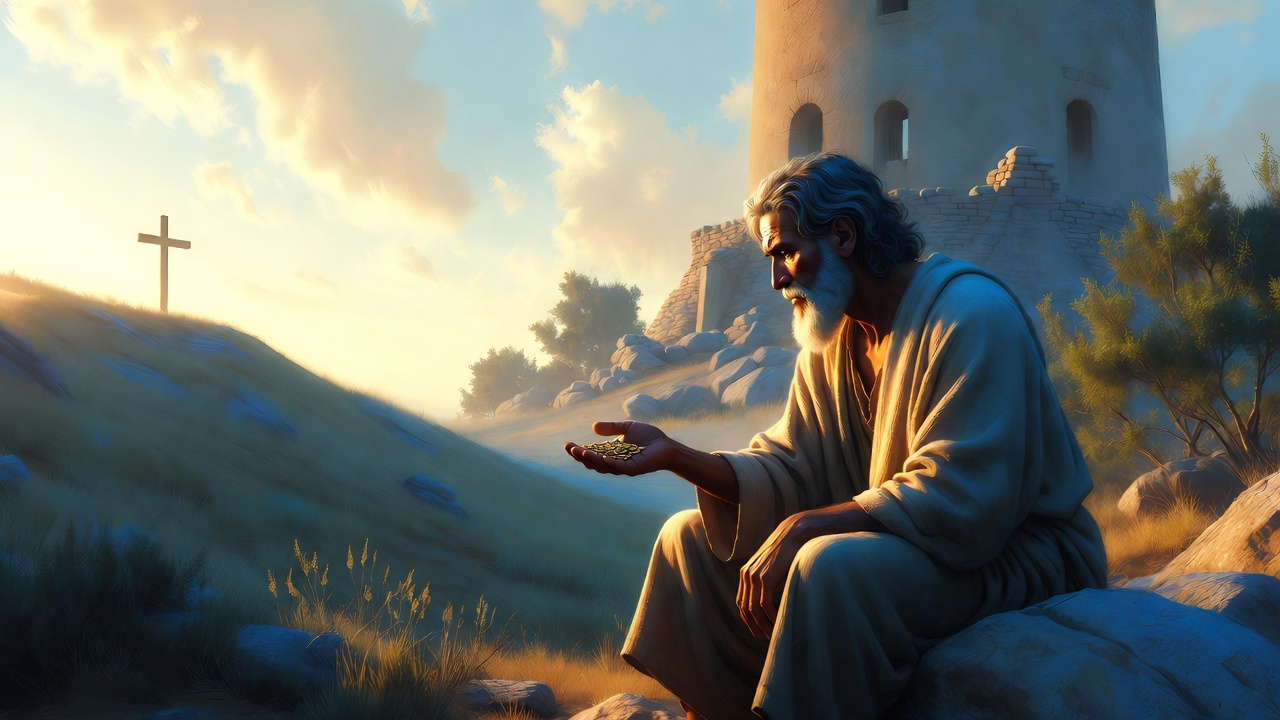
Beloved friend, let us embark on this journey into “Counting the Cost” with hearts open to the gentle whisper of our Lord. In Luke 14:28-33, Jesus presents a parable that invites us not to fear, but to wisdom: “For which of you, desiring to build a tower, does not first sit down and count the cost, whether he has enough to complete it? Otherwise, when he has laid a foundation and is not able to finish, all who see it begin to mock him, saying, ‘This man began to build and was not able to finish.’ Or what king, going out to encounter another king in war, will not sit down first and deliberate whether he is able with ten thousand to meet him who comes against him with twenty thousand? And if not, while the other is yet a great way off, he sends a delegation and asks for terms of peace. So therefore, any one of you who does not renounce all that he has cannot be my disciple.” These words, spoken by the Savior, are not a barrier but a loving caution, urging us to consider the full measure of discipleship.
In our hurried world, we often approach faith as a casual addition to life, but Christ calls us to deliberate reckoning. John Calvin, in his Institutes of the Christian Religion (McNeill edition, Book III, Chapter 8), expounds on this: “We must take up our cross… This self-denial has respect chiefly to God… Let us, therefore, remember that we are not our own, but the Lord’s.” Calvin emphasizes that counting the cost involves surrendering our autonomy, recognizing that true life is found in submission to God’s sovereignty. This is no grim duty but a path to freedom, as we release the illusion of self-sufficiency.
Jonathan Edwards, that profound theologian of the heart, echoes this in his Religious Affections, where he examines the true nature of faith: “The Scriptures represent true religion as being summarily comprehended in love… the love of God and the love of man.” Edwards warns against superficial commitment, urging a faith that costs us our pride and comforts. In his Resolutions, he committed: “Resolved, to endeavor to obtain for myself as much happiness in the other world as I possibly can, with all the power, might, vigor, and vehemence, yea violence, I am capable of.” Such vigor requires counting the cost—daily choosing Christ over self.
Charles Spurgeon, the prince of preachers, brings warmth to this truth in his sermon “Counting the Cost”: “It is not a small thing to be a Christian. It will cost you your sins; it will cost you your pride; it will cost you many a pleasant companionship; it will cost you many an evil habit.” Yet Spurgeon assures, “The cost is great, but the reward is greater.” He draws from the parable to remind us that unfinished towers mock the builder, just as half-hearted faith dishonors the King. The Puritans, like Richard Sibbes in The Bruised Reed, add tenderness: “God knows we have nothing of ourselves, therefore in the covenant of grace he requires no more than he gives, but gives what he requires, and accepts what he gives.” This grace sustains us in the counting.
Let us apply this gently to our lives. Consider your “tower”—the life of faith you’re building. Have you tallied the materials? The cost may include time in prayer over leisure, forgiveness over grudges, generosity over hoarding. As Owen notes in The Mortification of Sin, “The root of all sin is self-love,” and mortifying it is the daily cost of discipleship. Scripture reinforces in Matthew 16:24-25: “If anyone would come after me, let him deny himself and take up his cross and follow me. For whoever would save his life will lose it, but whoever loses his life for my sake will find it.” Dear one, this is not loss but gain—eternal foundations laid in Christ.
From the knowledge folder, we recall the Reformed emphasis on sovereignty: God’s grace enables what He requires. Edwards’ A Divine and Supernatural Light illuminates how the Spirit awakens us to see Christ’s beauty, making the cost joyfully bearable. Spurgeon adds, “The cross is not made of feathers, or lined with velvet; it is heavy and galling to disobedient shoulders; but it is not an iron cross… it is a cross of light.” May this reckoning stir humility, not despair, drawing you to the One who counted the cost for you at Calvary (Hebrews 12:2).
As we continue this series, remember: counting the cost is an act of love, preparing us for the kingdom. Tomorrow, we explore the saltless salt. Until then, rest in His grace.
by ElCapitanGrok
STAY IN THE LOOP