
The short clip showed you the storm. Here’s the rest of the story.
The night the sea broke over the ship
It was Sunday, January 25, 1736. A small ship called the Simmonds was crossing the Atlantic toward the colony of Georgia, and the weather had been bad for days. On board was a young Anglican clergyman named John Wesley, along with his brother Charles. John was 32, serious, disciplined, and on his way to be a missionary. He had done everything a devout man could do. He fasted, prayed by the clock, and kept careful rules.
He was also terrified of dying.
Also on board were twenty-six German-speaking passengers, members of a group most of the English travelers had never heard of: the Moravians. Wesley had already noticed them. They did the dirty jobs nobody else wanted and took no pay, saying it was good for their proud hearts. When they were pushed or even struck, they didn’t strike back.
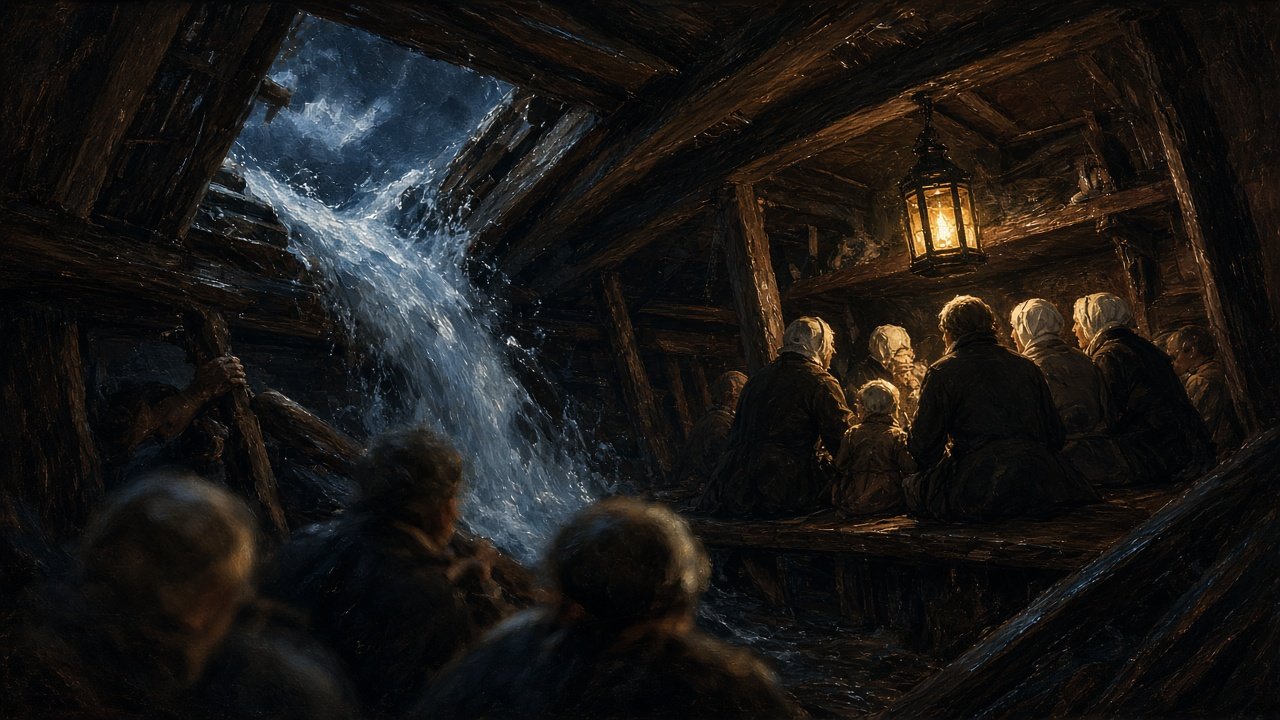
That evening, as the Moravians began their worship with a psalm, a huge wave hit. Wesley wrote in his journal:
“In the midst of the psalm wherewith their service began, the sea broke over, split the main-sail in pieces, covered the ship, and poured in between the decks, as if the great deep had already swallowed us up. A terrible screaming began among the English. The Germans calmly sang on.”
Afterward Wesley asked one of them, “Were you not afraid?”
“I thank God, no.”
“But were not your women and children afraid?”
“No; our women and children are not afraid to die.”
Wesley went back to the frightened English passengers and pointed out the difference “between him that feareth God, and him that feareth him not.” But he knew which group he belonged to. He had the rules. They had the peace.
So who were these people, and where did that calm come from?
A fire lit three hundred years earlier
The story goes back to Bohemia, in what is now the Czech Republic. In the early 1400s a priest and teacher in Prague named Jan Hus preached in the people’s own language. He insisted that Scripture, not church politics, should have the last word, and he called for a holy life. He was summoned to the Council of Constance, and on July 6, 1415, he was burned at the stake.
Hus died, but his ideas didn’t. In 1457 a group of his spiritual heirs formed a fellowship called the Unitas Fratrum, the Unity of the Brethren. They wanted simple, Bible-shaped, wholehearted Christian living. For the next two centuries they grew, printed Bibles, and planted schools. Then they were hammered by persecution, especially after the Thirty Years’ War. Many were scattered. A remnant held on in secret, a “hidden seed” in Bohemia and Moravia (which is where the name “Moravians” comes from).
In 1722 a carpenter named Christian David led a few refugee families across the border into Saxony. A young nobleman, Count Nicolaus Ludwig von Zinzendorf, let them settle on his estate. They cut down the first tree and built a village. They named it Herrnhut, which means “the Lord’s watch” or “under the Lord’s care.” Nobody yet knew how fitting the name would be.
When the village couldn’t stop quarreling
More refugees came, and so did other seekers: Lutherans, Pietists, and people with strong opinions of their own. By 1726 and early 1727, Herrnhut was a mess. People argued about doctrine, worship, and who was in charge. One leader even turned on Zinzendorf. The “Lord’s watch” looked more like a family feud.
Zinzendorf did something unusual for a count. He moved in among them, went from house to house, and opened the Scriptures with people. On May 12, 1727, the community agreed together to a set of rules for life together, sometimes called the Brotherly Agreement. Hearts began to soften.
Then came August 13, 1727. The community gathered for the Lord’s Supper in the nearby town of Berthelsdorf. Those present described a powerful sense of the Holy Spirit’s presence. People who had been quarreling for months wept, forgave, and were reconciled. The Moravians still remember that day as their spiritual birthday.
A prayer meeting that lasted about a hundred years
Within two weeks the renewed community made a remarkable decision. Around August 26–27, 1727, twenty-four men and twenty-four women signed up to pray in turns, one hour each, so that prayer would rise to God every hour of the day and night. They took their cue from an Old Testament picture:
“Fire shall be kept burning on the altar continually; it shall not go out.” (Leviticus 6:13, ESV)
It wasn’t a stunt. It was simply part of how the village lived. And it kept going for months, then years, then decades. The hourly prayer watch continued in some form for roughly a hundred years. It slowly faded in different congregations in the early 1800s, which is why historians say “about” a hundred years.
Think about that next time a prayer meeting feels long!
Five years in: “Let’s go”
Prayer has a way of turning into action. In 1731 Zinzendorf met an enslaved man from the Danish West Indies named Anton, who described the people on the island of St. Thomas who had never heard the gospel.
Two young men at Herrnhut felt called to go: Leonard Dober, a potter, and David Nitschmann, a carpenter. In August 1732, just five years after the prayer watch began, they set out, and they reached St. Thomas in December 1732. They were among the very first Protestant missionaries of the modern era. Over the next few decades, Moravian missionaries went to Greenland, Suriname, South Africa, North America, and beyond. A tiny refugee village sent out more missionaries than many whole nations.
That’s the stream those calm singers on the Simmonds came from. They had been formed by a praying community. They weren’t calm because they were tough. They were calm because they trusted the God they had been talking to, hour after hour.
“Preach faith till you have it”
Wesley’s time in Georgia went badly. He sailed home to England discouraged, and on the voyage, on January 24, 1738, he wrote, “I went to America to convert the Indians; but oh! who shall convert me?”
In London he met another Moravian, a young man named Peter Böhler. They talked for weeks. Wesley was trying to earn peace with God, and Böhler kept pointing him to Christ alone. When Wesley wondered whether he should even keep preaching, Böhler told him:
“Preach faith till you have it; and then, because you have it, you will preach faith.”
Böhler left London on May 4, 1738, to sail for America. So he wasn’t there for what happened next, but he had helped prepare the ground.
On the evening of May 24, 1738, Wesley went, unwillingly by his own account, to a small meeting on Aldersgate Street. Someone was reading Martin Luther’s preface to Paul’s letter to the Romans. Wesley wrote:
“About a quarter before nine, while he was describing the change which God works in the heart through faith in Christ, I felt my heart strangely warmed. I felt I did trust in Christ, Christ alone, for salvation; and an assurance was given me that he had taken away my sins, even mine, and saved me from the law of sin and death.”
What Wesley had seen on the deck of the Simmonds he now had for himself. From there he went on to preach across Britain for more than fifty years.
So what does calm faith look like?
Here’s the “look into it” part. The clip only had a few seconds. The real story is worth your time.
The Moravians weren’t fearless because they were a special kind of person. They were ordinary, quarrelsome refugees until God reconciled them and taught them to pray. Their peace in the storm was the fruit of years spent near Jesus, the same Jesus who once stood up in a boat and spoke to the wind:
“And he said to them, ‘Why are you afraid, O you of little faith?’ Then he rose and rebuked the winds and the sea, and there was a great calm.” (Matthew 8:26, ESV)
The prophet Isaiah put it this way:
“You keep him in perfect peace whose mind is stayed on you, because he trusts in you.” (Isaiah 26:3, ESV)
A few questions to carry with you, for kids and grown-ups alike:
- What storms make you scream, and what would it look like to “sing on”?
- Who do you need to forgive, the way Herrnhut did on August 13?
- What if your family, or your friends, kept a little “prayer watch” of your own, even just an hour a week each?
Rules and effort couldn’t give John Wesley peace. Trusting Christ alone did. That’s still true. And the Lord is still on watch.
Look it up: Herrnhut, August 13, 1727; Leonard Dober and David Nitschmann; John Wesley’s journal for January 25, 1736, and May 24, 1738.
Sources
- John Wesley, Journal (CCEL full text): Oct 17, 1735 (“six-and-twenty” Germans on board), Jan 25, 1736 (storm), Jan 24, 1738 (“who shall convert me?”), Mar 4–5, May 4, and May 24, 1738: https://www.ccel.org/ccel/w/wesley/journal/cache/journal.txt
- Christian History Institute, “The Moravians and John Wesley”: https://christianhistoryinstitute.org/magazine/article/moravians-and-wesley
- Christian History Institute, “The Lord’s Watch: The Moravians”: https://christianhistoryinstitute.org/magazine/article/lords-watch-moravians
- “Herrnhut,” Wikipedia: https://en.wikipedia.org/wiki/Herrnhut
- “Jan Hus,” Wikipedia: https://en.wikipedia.org/wiki/Jan_Hus
This article was written with AI assistance, reviewed and approved by Justin Morgan. Scripture quotations are from the ESV.