
Opening
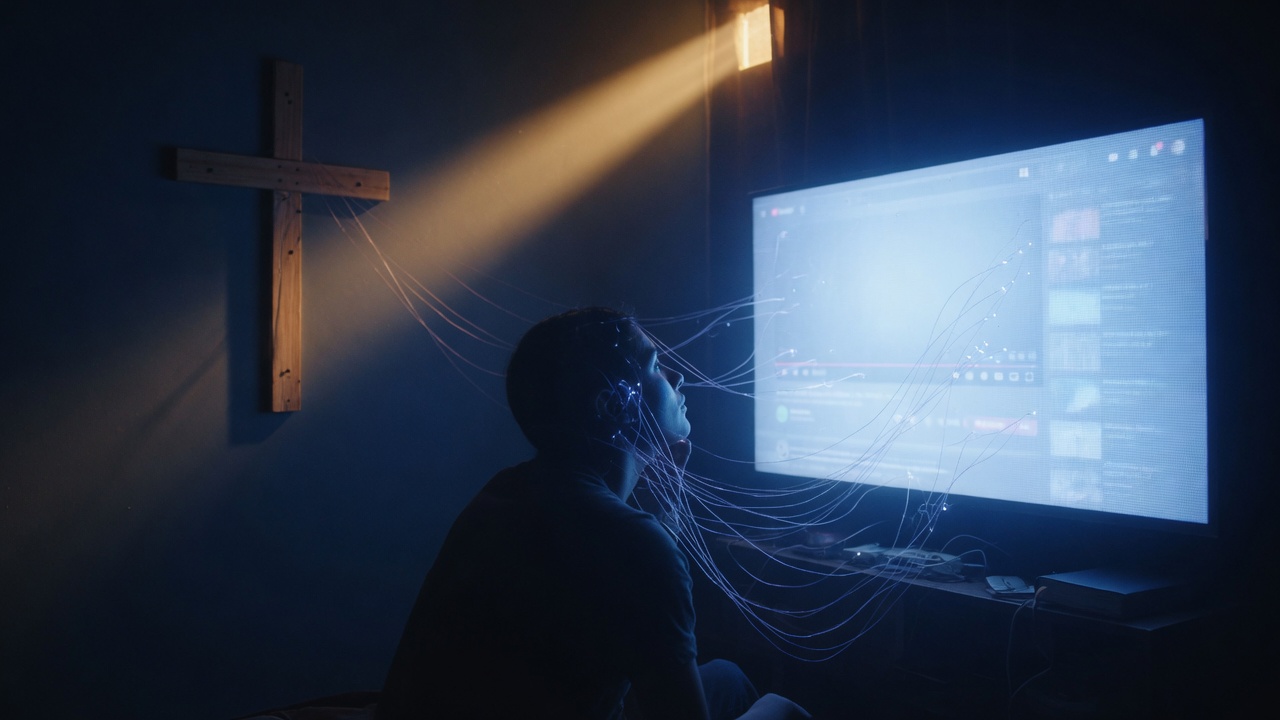
You prayed this morning. You may have read a few verses. You intend to serve Christ today. And later, without planning any rebellion, you will give three uninterrupted hours to a screen — a show, a game, a feed, a playlist — and God will scarcely enter your thoughts.
Not because the content is the worst thing on the platform. Ordinary media habits are built that way. Stories move fast. Music fills silence. The next episode autoplays. Nothing in the architecture asks, Where is your God while you watch?
If that sentence stings, stay with it. This article is not a rant against Hollywood or a call to sell your television. It is a mirror — a biblical audit of habits most Christians have never honestly measured. The question is not only whether you consume “bad” content. The question is whether you are being formed toward Christ while you consume, or whether you are being formed while believing you are only resting.
Biblical Foundation: Where Your Treasure Is, Your Mind Follows
Jesus does not treat attention as neutral. “For where your treasure is, there your heart will be also” (Matthew 6:21). The eye is the lamp of the body: a single eye fills you with light; a bad eye fills you with darkness (Matthew 6:22–23). Paul commands us to walk carefully, “making the best use of the time, because the days are evil” (Ephesians 5:15–16) — literally redeeming time.
The psalmist prays, “Turn my eyes from looking at worthless things; give me life in your ways” (Psalm 119:37).
The Formation You Did Not Vote For
Modern media works like a rival liturgy even when no one calls it worship.
Repetition moves content from entertainment into memory. Rhythm carries it into the body. Story supplies moral imagination. Emotion seals it.
None of that requires you to deny the gospel on paper. Formation is quieter than heresy. It happens while you are relaxed, tired, and off guard — when God-thoughtlessness feels like peace.
G. K. Beale puts the principle plainly: what people revere, they resemble, either for ruin or restoration. Tony Reinke speaks of competing spectacles — moments that fix our gaze and ask for our time, awe, or emotion. Augustine saw how fiction could train deep feeling without repentance.
Diagnostic: Hold Up the Mirror
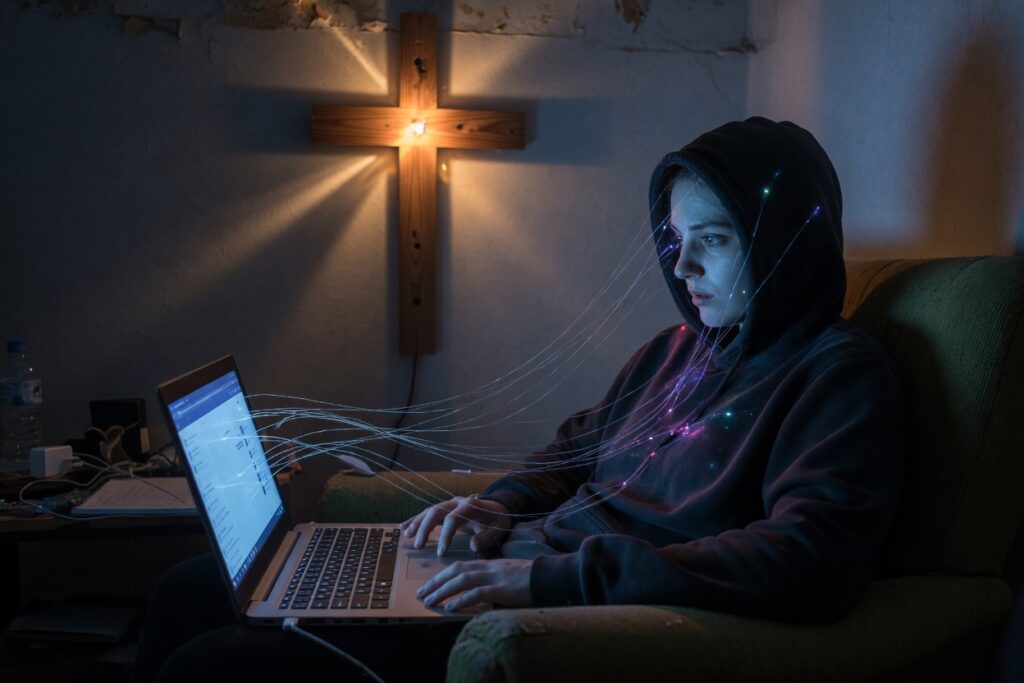
Read this section slowly. Answer for last week, not your ideal self.
1. The God-thought audit
Pick your three most common media habits (evening streaming, YouTube in bed, gaming, podcasts, music while driving, etc.).
For each, estimate total hours last week. Then ask:
- During those hours, did I speak to God in prayer beyond a quick meal grace?
- Did a verse of Scripture come to mind unforced?
- Did I think about my death, my accountability to Christ, or a specific neighbor’s need?
- When the session ended, what was my first thought — gratitude to God, craving the next episode, or emptiness?

2. The “Clean Content” Trap
Many believers pass a content filter and assume the audit is finished. Filters matter, but they are not enough.
Ask:
- Even when content is “clean,” whose kingdom supplies the moral imagination?
- Do I feel more eager to return to the story than to return to prayer?
- Have I ever been more emotionally engaged with a fictional character’s pain than with Christ’s cross?
3. The Pause Test
Modern media removes natural pauses. Ask:
- When did I last stop because I wanted silence before God?
- Do I use media to avoid prayer, confession, or boredom that might drive me to Scripture?
- If autoplay were disabled tomorrow, would I feel relief or irritation?
What the Audit Reveals
If you answered honestly, you may recognize common patterns:
- High hours, low God-thought — formation in God’s absence.
- Clean content, but worldly imagination.
- Removed pauses, weakened repentance.
None of these requires obvious vice. The issue is rival centrality: what receives your best attention, repetition, and emotional energy — Christ or the feed?
Gospel Hope and Repentance
Christ did not die to baptize your distractions. He died to bring you near — to give you a new heart and a single-eyed loyalty.
Repentance here is not crushing guilt. It is returning to your first love. Confess specifically: Lord, I have given hours to stories and sounds while barely thinking of You. Ask for mercy and renewed desire. He is the Bridegroom who welcomes the waking soul.
Your Next Seven Days: Questions and Experiments
Do not leave this as mere information.
Diagnostic questions to carry through the week:
- How many hours did I give to media vs. unhurried Scripture and prayer?
- When the screen went dark, what was my first thought?
- What did I repeat most, and what desire did it drill?
- Did I choose silence before God at least once?
Simple Experiments (pick two):
| Experiment | What to do | What to notice |
|---|---|---|
| God-thought log | Set a timer every 15 min during one media session. Ask: Have I thought of God? | Whether God enters naturally |
| Autoplay off | Disable autoplay for seven days | Irritation vs freedom |
| First-hour swap | Before any media, read one Psalm and pray for five minutes | How prayer changes the atmosphere |
Closing
You may be a sincere believer and still be barely thinking about God in the hours that shape your loves. That is the ordinary drift of our age.
The rest of this series will trace how we arrived here and point more fully to Christ as the true spectacle that reorders every lesser one. But the work begins here — with an honest audit and a returning heart.
Trim the lamp while there is still time. Ask God to turn your eyes from worthless things and give you life in His ways. He will.